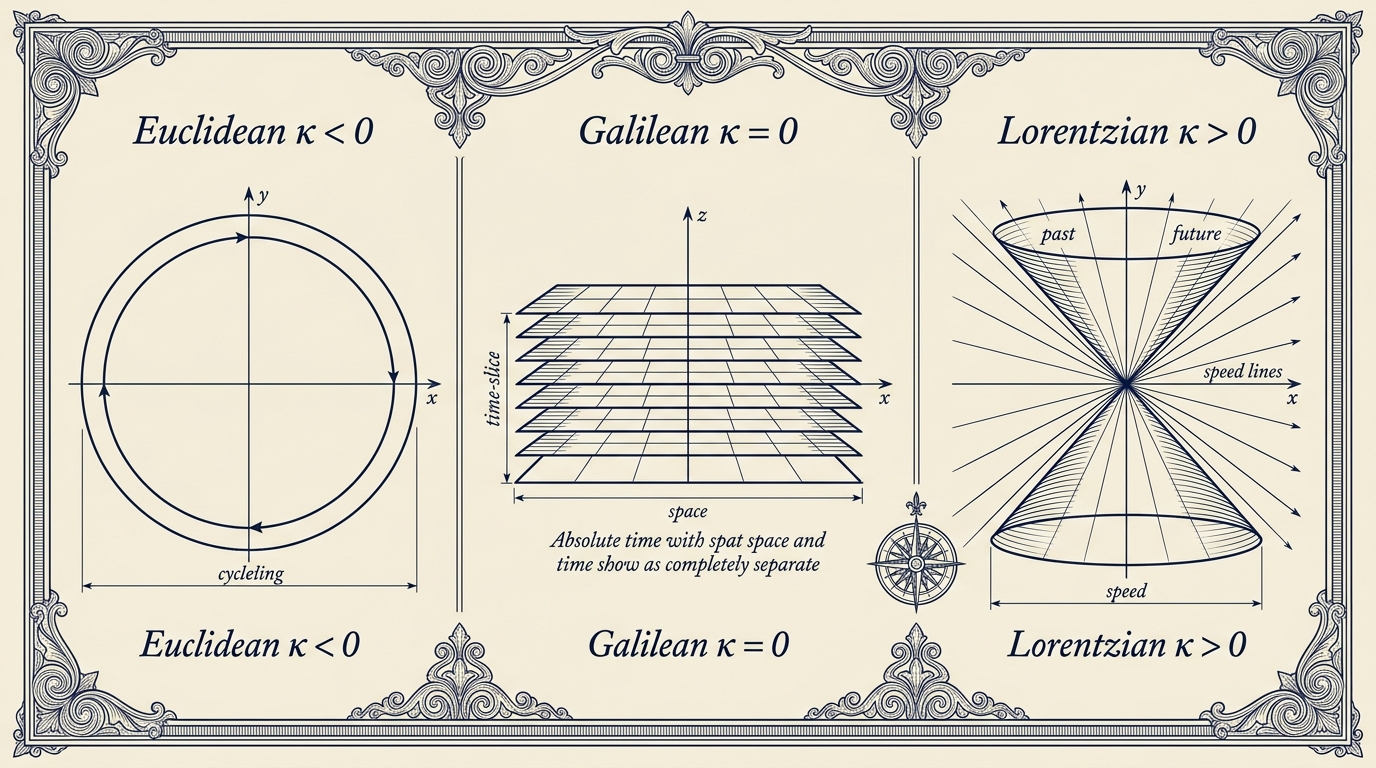
The three possible universes defined by the sign of κ. Each is a self-consistent geometry, and only one admits causal physics.
The Starting Point
The Transformation Equations
From Postulate I alone, with κ left as a free parameter, the algebra forces the following form of the coordinate transformations between inertial frames.
How time transforms between moving frames
How space transforms between moving frames
The stretching factor — depends entirely on κ
Key insight:These three equations follow from Postulate I alone, with κ left as an unknown. No assumption about light. No specific velocity. Just symmetry.
The Three Cases
What Each Value of κ Produces
κ < 0 — The Euclidean Universe
A Universe Without Yesterday
When κ is negative, the transformation equations describe a universe where all four dimensions are equivalent, like a sphere where you can rotate in any direction freely. Space and time are indistinguishable. There is no 'past' or 'future.' Causality is impossible. If you can't say which events came before others, you can't have physics.
κ = 0 — The Galilean Universe
Newton's Universe — But Incomplete
When κ = 0, the transformation equations collapse to the Galilean form: x′ = x − vt, t′ = t. Time is absolute and the same for everyone. There's no mixing of space and time. This is Newton's universe, which works perfectly at everyday speeds. But something is broken: the algebra goes blind on the boosts. The Killing form cannot measure the boosts at all; they contribute nothing to the diagnostic. The algebra is incomplete.
κ > 0 — The Lorentzian Universe
The Universe That Carries Its Own Speed Limit
When κ > 0, the algebra is self-consistent and complete. A lightcone structure appears. Space and time mix under boosts. And crucially: the equations set their own internal speed scale. V = 1/√κ is not a choice. It's what the algebra produces. You need experiment only to measure what this speed is in our universe.
Summary
The Three Universes Compared
| Property | κ < 0 | κ = 0 | κ > 0 |
|---|---|---|---|
| Killing Form (Diagnostic) | Negative definite | Degenerate (blind on boosts) | Positive on boosts |
| Invariant Speed | imaginary | undefined | V = 1/√κ (emerges from algebra) |
| Spacetime Metric | Euclidean (+,+,+,+) | Degenerate | Lorentzian (−,+,+,+) |
| Causal Structure | None (no past / future) | none | Full lightcones |
| Algebra Self-Contained? | Yes, but causality-free | No — boosts invisible | Yes ✓ |
| Space and Time Unified? | Over-unified (indistinguishable) | Not unified | Unified under boosts ✓ |
✓ indicates the algebraically consistent, causally viable universe.
The sign of κ is not a philosophical preference. It is a mathematical verdict, delivered by the algebra itself.— One Postulate (paraphrase)
The Killing form acts as the diagnostic. κ < 0 eliminates causality. κ = 0 blinds the algebra to boosts. Only κ > 0 passes both tests, and with it comes an invariant speed, a lightcone geometry, and the full structure of Special Relativity.